O.O.D.E. Orthodox Outlet for Dogmatic Enquiry |
Category: God |
When a tragedy is used as “evidence”
that there is no God...
( A Response to a related atheistic comment*** by Archimandrite Christodoulos )
Greek source: https://www.facebook.com/permalink.php
|
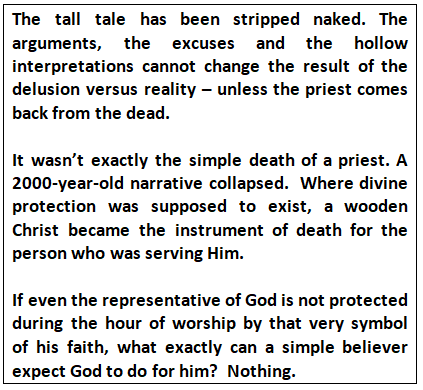
A statement**
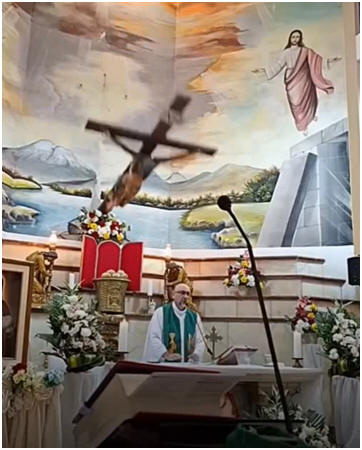
recently appeared in a social media post, prompted by the news of the
tragic death of a priest during an officiation, which inspired the
following conclusion:
If
a man of God was killed inside a church - and by a religious symbol
no
less - then the Christian narrative about divine protection has
crumbled.
The argument sounds compelling. The only problem is that it touches on
an aspect of Christianity that Christianity itself never taught.
When, exactly, did Christ promise that whoever believes in Him would
never fall ill, suffer, face injustice, or die a tragic death?
The fact is, He proclaimed quite the opposite.
-Christ did not descend from the brutal Crucifix.
-His Apostles did not live and preach protected from every danger.
-Peter was crucified, Paul was beheaded, and Stephen was stoned to
death.
-The first Christians suffered persecution, imprisonment, and martyrdom
for their faith.
If therefore the violent deaths of believers is proof that Christianity
is false, Christianity would have already been "disproven" as early as
the first century after Christ.
And yet, Christianity was born precisely during that brutal reality.
The mistake lies elsewhere: we confuse divine protection with
corporeal immortality. In other words, we believe that if there
is a God, a believer must surely be sheltered beneath an invisible
protective dome that ensures no accidents will occur, no cancer will
appear, no tree will fall on them, no devastating earthquake will
strike, and no one will murder them.
But that is not the Gospel.
Christ did not come to temporarily abolish biological death. He came to
conquer death through the Resurrection.
That is why the core of the Christian faith is not about an ordinary
human being who escaped death; it is about a God who passed through
death and was re-surrected.
In fact there is a strange contradiction in the argument: "A
wooden Christ killed the priest; therefore, the faith has collapsed."
The thing is, that specific, wooden Crucified One is not God.
It is an image, a material object made of
wood. Just as an oil lamp can begin a fire, a church bell can fall and
kill someone, and an entire temple can collapse during an earthquake.
A Christian does not believe that sacred
objects are not subject to the laws of nature.
The Cross is not an amulet for magical protection.
And herein lies perhaps the most profound
misunderstanding:
Faith does not say "You shall not die." It
says: “Even if you die, death is not the end of you.”
Christ Himself had very impactfully said those words, standing in front
of Lazarus’ tomb:
“I
am the resurrection and the life; he who believes in Me, even though he
dies, he shall live.”
Note carefully: He did not say, “He who believes in Me will not die.”
He said, “even
though he dies...” Even when he dies.
Subsequently, the tragic death of a priest does not constitute a
refutation of the Gospel. Just as the beheading of John the Baptist was
not a refutation. Just as the stoning of Stephen was not a refutation.
And, above all, just as Calvary itself was not a refutation.
The major question of Christianity is
not: “Why didn’t God prevent
this person from dying?”
The deeper question is: “Is death the end of
man?”
That is where everything is judged.
And of course one has every right to respond with: “I don’t believe in
the Resurrection.” This is a serious stance, and it can be discussed -
philosophically, historically and theologically.
But that is quite different to saying: “A
believer has died; therefore it proves that Christianity is a lie.”
Because Christianity never claimed that
believers do not die. It claimed something far bolder: that
death cannot hold on to them forever.
And that is why the image of a dead priest
does not mark the end of the
Christian narrative.
Besides, the Christian narrative began to be truly mind-blowing,
precisely in the presence of a Tomb.
And its final word is not “death.”
It is: “Christ is Risen!”
***
Translation AN |
File created on the 25-10-2026
Last update on the 25-10-2026