| Orthodox Outlet for Dogmatic Enquiries | On God |
|---|
A Study on the 'Filioque' Addition
The role of prepositions in the text of the Creed
by Professor Emeritus Panayiotis Boumis - Athens University
|
As it turns out, the basic reason for the
insertion of the term “Filioque” (= “and the Son”) in the
Latin Creed (Symbol of Faith) is the omission to discern between the
prepositions ‘ex’ and ‘a’ of the Latin
language.
This omission is usually also
observed with the Greek prepositons ‘εκ’ or ‘παρά’ - including those of the olden Greek language, when rendering them in
modern Greek. However,
we need to be aware of the following:
In general, the prepositions ‘εκ’ or ‘παρά’ (in olden Greek) have the nuance of
immediacy - as does the Latin ‘ex’; whereas the
preposition ‘από’ has the nuance of mediation -
as does the Latin ‘a’ or ‘ab’ (=by).
More analytically and more specifically
-particularly in the case of the “Filioque” addition- we need to
point out the following:
The meaning and interpretation of the Greek
prepositions ‘εκ’ or ‘παρά’ is ‘on the part of’ /‘from’: meaning that the Third Person
(=the Holy Spirit) of the Holy Trinity ‘proceeds’
immediately/directly from/on the part of
another Person (=the Father), without the
Second Person of the Trinity (the Son) being ‘interpolated’ between
them, and Who -as such- does not participate in the Holy Spirit’s
procession/origin from the Father.
On the contrary, the nuance of the
preposition ‘από’ is that of mediation – which
means that the Third Person of the Trinity (the Holy Spirit) also
proceeds from another person (besides the Father).
Thus, if used, the Greek preposition ‘από’ would allow another Person of the Trinity
(the Son) to interpolate and to participate with the other two
Persons of the Trinity (the Father and the Holy Spirit).
In which case, the other
Person (the Son) could participate in the Holy
Spirit’s procession and origin.
The same thing occurs in Latin: The
preposition ‘ex’ signifies the immediate, the direct
procession-origin of the one Person (the Holy Spirit) from another
Person (the Father), without the participation, without
the interpolation of another Person (the Son).
Conversely, the preposition 'a' – ‘ab’ (= by, from),
by virtue of its mediation,
allows for the
possibility that the proceeding Person (the Holy Spirit) can also
proceed from another Person - meaning that ‘another’ (the Second
Person - the Son), can interpolate between the first Person (the
Father) and the third Person (the Holy Spirit). In other words, that
the other person (the Son) participates in the Spirit’s procession.
Pursuant to all the above, if we ignore and
overlook the difference in meaning of the prepositions ‘παρά’, ‘εκ’ and ‘από’ in olden Greek, as well as of the Latin ones of ‘ex’ and
‘a-ab’, it is easy for one to get carried away into an
error.
It is therefore necessary, when someone
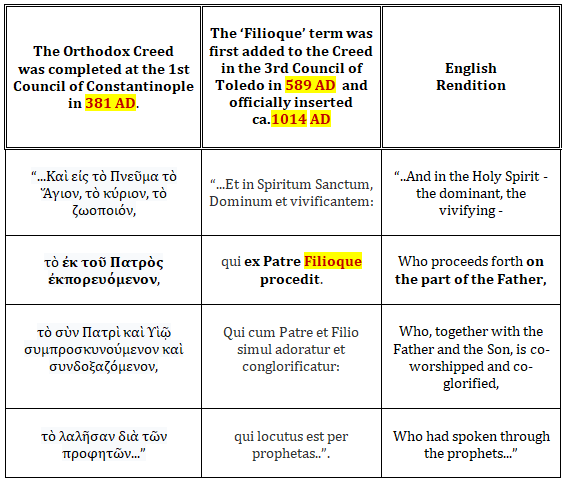
uses the Greek prepositions ‘εκ’ or ‘παρά ‘ - and the ‘ex’ (= the Latin of ‘εκ’ or ‘παρά’) in the Latin text of the Creed - to write
only the established wording of ‘Who proceeds from the
Father’ -
WITHOUT the insertion of the term ‘Filioque’ (=and
from the Son), because as mentioned earlier on, the prepositions ‘εκ’ - ‘παρά ‘ - ‘ex’ all contain the nuance of immediacy : without
any mediation.
But when one uses the preposition ‘από’ or ‘a/ab’ (= from, by) they have
the potential to insert “and of the Son” (=Filioque), because the
nuance of mediation in these prepositions makes such an allowance.
And now we have reached a crucial point,
which we must notice very carefully.
The New Testament in the original, olden Greek (the ‘koine’)
syntax has the preposition ‘παρά’ (= on the part of) as follows:
“...the Holy Spirit...Who proceeds forth on the part of the Father...” This syntax does
not make allowance for the insertion of 'and' ( ‘και εκ’ = and
on the part of) the Son (per the Filio-que); in other words, for another Person to be
interpolated between the Father and the Holy Spirit.
Unfortunately, however, the first
translator Fathers of the New Testament had – from the olden Greek
(‘koine’) to Latin (out of ignorance?) – had used the preposition ‘a/ab’
(= by, from) into a text of the Evangelist John, instead of the
preposition ‘ex’ (= ‘out of’ or ‘on
the part of’). Hence it
was (and still is) easy for anyone to get carried away and insert
the term “Filioque” (= “and from the Son”) in the Latin Creed, or,
to even defend the infiltration of the Filioque in the Latin Symbol
of Faith.
But it is also easy to perceive -after all
the above- the error in the Latin Symbol of Faith as well as its
usage in the Latin text of the Bible, and to make the due
corrections; That is,
the preposition ‘ex’ (= on the part
of) should be used in the
Latin Bible – the way it is in the Latin Creed -
and the “Filioque” addition
should then be removed from the Creed.
It must be noted and stressed here that,
initially by the second Ecumenical Council in Greek (and for
centuries after, also in Latin), the Symbol of Faith contained the
correct preposition ‘ex’ (and not the preposition ‘a’),
and the ‘Filioque’ addition was absent.
As confirmation of the above, we are
quoting below the passages that pertain to that which had
preoccupied us until now and is included in them.
This will prove the affinity
between all the verses of the Holy Bible.
(a)
John 14:16-17: “And I (Christ) shall ask the
Father, and He shall give you another Consoler,
-The Holy Spirit is also referred
to as the ‘Paraclete’ – the Consoler, the One Who is called upon
by...
-The Father gives us the Paraclete
- the Holy Spirit.
-The verb 'give' appears to mean
“proceed” as well as “send” .
-The Son asks the Father for this.
-The Son is also named
“Paraclete”.
(b) John 14:26: 'And the Paraclete, the Holy Spirit,
Whom the Father will send
in My name, He will teach you all things...'.
-The Father also dispatches (= sends) the Holy Spirit.
(c) John 15:26: 'But when the Consoler comes, whom I will send to
you on the part of the Father - the Spirit of truth who proceeds
on the part of the Father - He will testify of Me.'
-Twice is the Greek preposition ‘παρά’ (= on the part
of) used , and not the
Latin ‘a-ab’.
-‘Proceeds’ is one thing and ‘sent’ is another. The Father sends. But the
Son also sends. This is also evident from the passage John
14:26.
(d) John 16:7: 'But I tell you the truth: it is profitable for you
that I should depart. For if I do not depart, the Consoler will
not come to you. But if I go, I will send him to you.'
- The Son also dispatches (= sends) the Holy Spirit.
(e) John. 16:13: 'But when the Spirit of truth comes, He will lead
you into all truth.'
-The Holy Spirit guides the apostles, the members of the Church, and the
entire Church.
f) 1John 2:1: 'My children, these things I write to you, that you
may not sin; and if anyone sins, we have a Consoler towards
the Father: Jesus
Christ the just.' - Jesus Christ also is and is called “Paraclete”.
In brief:
• The Father “sends forth” the Holy Spirit;
He “gives” the Holy Spirit, and He “dispatches” the Holy Spirit.
• The Son “sends” the Holy Spirit and asks
for this from the Father.
• The Holy Spirit is “emitted” (proceeds
forth) only on the part (‘εκ’, ‘παρά’, ‘ex’) of the Father.
Given the above data, each one of us can
contribute to the return of the West to its original path, the
upright path – and, why not? - to the unity of all Christians - of
the East and the West.
Bibliographic support
(indicatively):
• Vraka Ant., The Grammar of the Latin
word, Athens 2008.
• Kakridi Th., Grammar of the Latin
Language, Athens 1964.
• Katevaeni Kon., Syntacticon of the Greek
Language, Athens 1965.
• Tzartzanou Ach., Grammar of the Ancient
Greek Language, Athens 1962.
• Tzartzanou Ach., Syntactic of the ancient
Greek language, Athens 1976.
Translation: KN |
Article published in English on: 11-11-2025.
Last update: 11-11-2025.