| Orthodox Outlet for Dogmatic Enquiries | Society - Politics |
|---|
The Pagan Roots of Nazism:
A Deep Contrast with the Values of Romiosyni
By Christodoulos Molyvas
Source
: https://thiapoliteia.blogspot.com/2026/05/pagan-roots-nazism-vs-romiosyni1.html
|
Introduction
National Socialism was not merely a political movement; it was a
system with deep mythological, esoteric, and neo-pagan
foundations. Behind Hitler’s speeches and the military parades
lay a world of runic symbols, ancient Germanic mythology, and
occult societies that profoundly shaped the ideology of the
Third Reich in its darkest depths.
1. The Völkisch Movement and the "Racial Soul"
In the late 19th century, the Völkisch movement developed in
Germany—a blend of nationalism, romanticism, and pagan revival.
Its representatives rejected Christianity as a "Jewish" religion
and sought the "authentic" spiritual roots of the German people
in Germanic-Norse mythology: Wotan (Odin), Thor, and Valhalla.
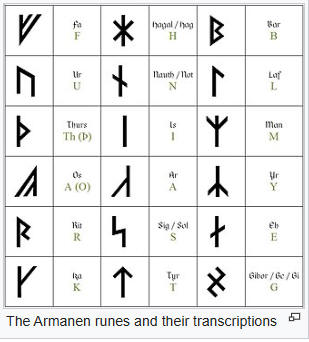
Guido von List (1848–1919) was among the first to associate
runic letters with racial mystical significance, developing the
Armanenrunen system.
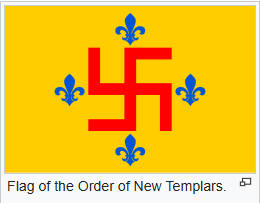
Jorg Lanz von Liebenfels founded the order Ordo Novi Templi,
publishing magazines that combined archaic paganism with
virulent racial theories.
2. The Thule Society: The Occult Bridge to Politics
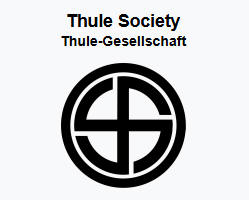
The Thule Society (Thule-Gesellschaft, 1918) was perhaps the
most decisive link between occultism and politics. Its name
referred to the mythical "Ultima Thule"—the alleged primordial
homeland of the "Aryan race."
Members believed in an ancient, spiritually superior Hyperborean
civilization from which the "Germanic race" descended. Their
emblem was the swastika—an ancient Indo-European symbol to which
they assigned a racialist meaning. From the circles of Thule
emerged the German Workers' Party, which Hitler later renamed
the NSDAP.
3. The SS and Heinrich Himmler: A New Teutonic Order
Heinrich Himmler was the preeminent "pagan" of the Nazi regime.
He envisioned the Schutzstaffel (SS) not as a mere military
force, but as a priestly brotherhood inspired by medieval
knights.
Wewelsburg Castle was transformed into a "sacred site" for the
SS, complete with rituals and occult symbolism.
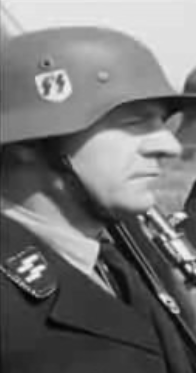
Runic Symbols were used extensively; SS members adopted the
double Sig (⚡⚡)
as their dreaded emblem.
The Ahnenerbe was a pseudo-scientific organization founded to
search for evidence of "Aryan superiority" from Tibet to
Scandinavia.
4. The Appropriation of Symbols
The swastika (Hakenkreuz) and the runes were not Nazi
inventions, but ancient symbols appropriated for a racialist
narrative.
Sig (ᛋ)
was the symbol of victory used as the SS emblem.
Odal (ᛟ)
was the symbol of heritage and land used by agrarian
organizations.
Leben (ᛚ)
and Tod (ᛏ)
were the life and death symbols used on SS gravestones to
replace the Christian cross.
5. Hitler, Rosenberg, and the Anti-Christian Agenda
While Hitler used Christian language publicly for political
expediency, he privately expressed deep contempt for the faith.
In his "Table Talk"(Tischgespräche), he famously stated: "I
cannot stand Paul... he is the one who destroyed the ancient
world."
Leading ideologues like Alfred Rosenberg sought to replace
Christianity with a "Germanic religion" based on the "Myth of
the Blood" and the ideology of Blut und Boden (Blood and Soil).
6. The Radical Contrast with the Values of Romiosyni
The neo-pagan and racialist worldview
of Nazism stands in absolute historical and spiritual opposition
to the principles of Romiosyni(the Hellenic-Orthodox tradition).
This conflict is not merely political, but deeply ontological.
Universalism vs. Ethno-racialism
Nazism deified biological descent and racial segregation.
Conversely, Romiosyni is defined by Universalism, rooted in the
Pauline "There is neither Jew nor Greek," asserting that a
person's value is spiritual, not biological.
The Person vs. The Mass
In Nazism, the individual is a disposable cog in the "Race"
(Volk). In the Orthodox tradition, the human is approached as a
"Person"(Imago Dei), possessing absolute, inalienable, and
eternal value regardless of origin or capacity.
Love and Sacrifice vs. The Law of the Strongest
Nazi neo-paganism adopted Social Darwinism, glorifying the
extermination of the weak. Romiosyni proposes the exact
opposite: love, solidarity, and sacrificial self-offering (the
"kenosis" of the strong for the sake of the weak).
Spiritual Freedom vs. "Blood and Soil"
The Blut und Boden ideology confines man to animalistic
instincts. Romiosyni calls for the transcendence of natural
necessities through the ascetic life, aiming for spiritual
freedom and the transfiguration of the world.
Conclusion
The pagan dimension of Nazism was a
structural element used to build a totalitarian "anti-religion."
Its conflict with the universal and person-centered nature of
Romiosyni remains a critical chapter in the history of ideas,
reminding us how easily evil can cloak itself in the language of
the "sacred."
Sources & Bibliography
Historical & Occult Research
-Goodrick-Clarke, Nicholas. The
Occult Roots of Nazism: Secret Aryan Cults and Their Influence
on Nazi Ideology.
NYU Press, 1993.
-Pringle, Heather. The Master Plan: Himmler’s Scholars and the
Holocaust. Hyperion, 2006.
-Trevor-Roper, Hugh (ed.). Hitler's Table Talk 1941–1944. Enigma
Books, 2000.
-Rosenberg, Alfred. Der Mythus des zwanzigsten Jahrhunderts (The
Myth of the Twentieth Century), 1930.
-Kershaw, Ian. Hitler: 1889-1936
Hubris. Penguin Books, 1998.
Theological & Philosophical Context (Romiosyni)
-Romanides, John S. Romiosyni. Pournaras Publications, 1975.
-Yannaras, Christos. The Freedom of Morality. Ikaros, 1970.
-Chapoutot, Johann. The Law of Blood: Thinking and Acting as a
Nazi.
Belknap Press, 2018.
|
Article created : 10-5-2026.
Last update : 10-5-2026.