| Orthodox Outlet for Dogmatic Enquiries | Holy Bible |
|---|
What, finally, was the Ark of the Covenant?
Is there a reason it hasn’t been found to this day?
|
Where is the most sacred and most dangerous object in all of
history? We are talking about the Ark of the Covenant. God's
visible throne on earth. And after nearly a thousand years of
documented history, it
vanished. Without explanation, without a trace, without a single
verse in the Bible telling us where it went.
Today, we are going to do something that has never been done
before. We are going to
create the definitive map of the Ark of the Covenant. We are
going to follow its journey from the exact place where it was
built, to the moment it disappeared. Every precise point where
God's presence touched the earth, mArked on the map.
And what you are about to discover
is that this journey is
not random. There is a pattern. Four men
carried it on their
shoulders for 40 years through a shadeless desert. It traveled
more than 600 km. And
wherever it went, something extraordinary happened, it struck
dead anyone who touched it irreverently. It humbled pagan gods.
It stopped rivers. It brought walls crashing down. And it
unleashed plagues upon one
of the mightiest civilizations of its time.
Until one day, without warning, it vanished from
the pages of History.
What was this box really? What was inside? Why did it
kill anyone who touched
it?
It all started here, on Mount Sinai – 1446 B.C...
Moses had been on the mountaintop for 40 days. 40 days without
food, without water, shrouded in
the cloud that covered the mountain like an unquenchable
fire. The people waited below, terrified. And up there,
God didn't just give him
a Law. He gave him the most detailed construction plans
ever dictated. Plans for an object that would change the course
of world History. The Ark of the Covenant. The dimensions were
exact: 111 cm long, 67 wide, 67 high.
God gave it a ratio of
5:3:3. Mathematically perfect.
When Moses comes down from the mountain with the stone tablets
and returns to the camp, a man is waiting. His name is Bezaleel.
And what Scripture says about him is extraordinary. It doesn't
say Bezaleel was Israel's finest craftsman. It says God filled him with His Spirit. He
gave him wisdom, understanding, and knowledge in every kind of
craft. This is astonishing. The spirit of God came upon this
man, not to prophesy, not to preach, but to work with his hands.
God came down so that human hands would shape His dwelling on
the earth, to cut wood, to cast gold, and to craft
something perfect.
Bezelel begins to build. But he does not work alone. He is
joined by Aholab from the tribe of Dan and a team of artisans
whom the Bible says were
also endowed with wisdom for the work. But it is Bezaleel who
receives the instructions firsthand. It is Bezeleel who sees in
his mind what no one has seen
before. And the first thing he needs is wood. But not just any
wood. Acacia wood from the wilderness of Sinai. If you've never
seen acacia from Sinai, here's something you should know. It's
one of the hardest woods on Earth. So dense that
insects can't pierce it.
Bezaleel took that wood and built an Ark to the exact
dimensions. Then he overlaid it with pure gold. Not just
outside, but inside as well. Gold within, gold without, and in
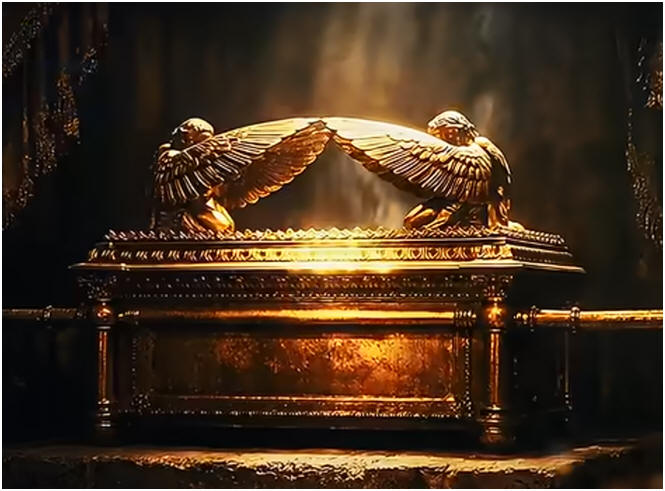
between that indestructible wood. And then, on the top of it, Bezaleel
makes the most
astonishing piece of all, the kapporet -the atonement
cover- what many know as
the “Mercy Seat”. This piece is solid
gold, pure, hammered
from a single piece. Then Bezeleel shapes two cherubim, one
placed at
each end, wings lifted high, leaning toward each other, forming
a space between them.
That space, that gap between the cherubam's wings was the
holiest place in the universe. And there, exactly there, in that
space between the wings, God says, "From
there, I will meet with you and speak with you - from above the
mercy seat, from between the two cherubim."
(Exod.25:22)
Think about what this means. God chooses a specific spot on the
earth, a spot that fits
between two figures of gold, atop a box that a group of men can carry
on their shoulders. Bezeleel also casts four gold rings and
fastens them to the
Ark's corners. Through those rings slide two long poles made
from acacia
wood and overlaid with gold.
And here's a crucial detail. Exodus 25:15 says “the
poles must never be
removed. Never. The Ark must always be ready to move”.
God doesn't settle in. God walks.
His presence advances,
accompanies, and goes before His people.
How much did the Ark weigh? It's hard to pin down exactly. What
we do know for certain is who was allowed to carry it. Only the
Levites from the family of Kohath were authorized to transport
it. No one else. And never by touching the Ark itself. Only by
the poles. Because to touch the Ark itself meant death. Inside
the Ark, Bezelel and
Moses placed three items.
Pay attention: The first was
two stone tablets inscribed by the very finger of God. It's the
only inscription in all
of History that the account ascribes to the Creator's own hand. The
second item was Aaron's
staff, a dead piece of wood that one day budded and bore
almonds. And the third, a jar of manna, the "bread from heaven"
that - kept in the jar - never spoiled.
At last, the Ark was finished. God's dwelling on earth was
complete. And then the
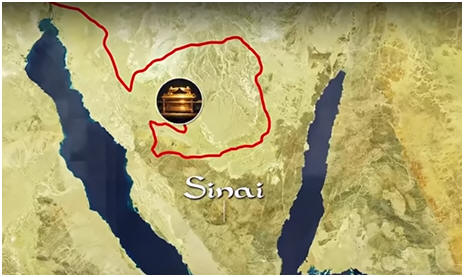
Ark was lifted and it began to move. The Ark moved across the Sinai
Peninsula for 40 years. And behind it came a nation of more than
2 million people walking the desert with no horizon in sight, no
destination. They simply followed the erratic, unseen map traced
by the most sacred,
deadly, and mysterious object of the ancient world. If you tried
to draw Israel's Exodus on a map, you'd find a baffling detail.
The route makes no sense. It curved, doubled back, and snaked
its way for four decades. 40 years without a straight line. It
looked like the path of someone walking with eyes shut, trusting
only a voice that no one else could hear.
We tend to picture the Ark always guarded
at the center of the
people of Israel. And yet, the Biblical reality is quite different.
The Ark went alone - out front. It would go a full 3 days’ journey
ahead, to open the way and to seek a resting place for a people
who still didn't know
where they were headed. Its movement was the only law. Whenever
the Ark rose, Moses spoke the
same words. “Rise up, Lord, and let Your enemies be scattered”.
(Numb.10:35). And whenever
it came to rest, he
said, "Return, Lord, to the thousands upon thousands of Israel."
(Numb.10:36).
If the Ark moved, millions walked. If it
stopped, the people made
camp. And there lay the most astonishing paradox. The Ark was
carried unseen.
The Kohath never saw the
Ark. No bearer ever did... Imagine devoting your entire life to
carrying something you're forbidden to behold. You feel its
weight under a 113° sun.
You know every creak in the wood, every sway of the load. You
know everything about the Ark - everything, except what it looks
like. Your father carried it before you, your grandfather before
him. and one day your
son will take your place. He won't see it either. For they knew
that if they ever looked upon it, they would die on the spot.
Before each departure, the priests entered the
Holy of Holies. They
took down the heavy veil that separated the sacred from the
common and wrapped the Ark
in it. Over that, they laid a layer of thick badger hides to
shield it from the brutal elements, and finally a mantle of pure
blue, three impenetrable veils. Only when it was fully hidden
would the Levites of the
clan of Kohath step in to lift the poles. Every night the Ark
came to rest at the center of the camp. The 12 tribes pitched
their tents in strict order: three to the North, three to the
South, three to the East, and three to the West. Had we looked
down on that camp from the sky, we would have seen a
perfect Cross traced in
the desert sand. An entire nation arrayed with geometric
precision around a single object - like a solar system.
Israel's center of
gravity was not its leader nor its army. It was an empty space
between the wings of two cherubam, the exact place
where God had promised
to dwell. So they marched for four decades, wandering the
wilderness, walking blind yet in perfect order,
trusting in what they
could not see - until in 1406 BC, the Ark suddenly stopped. Before
them there was no more sand, no more desert. The swollen waters
of the Jordan River surged, cutting off the way.
Everything was about to
change - forever. At last, they had arrived. Before their eyes,
the Promised Land stretched out.
The land their parents had dreamed of. The land for which an
entire generation had been buried
in the desert sands. But the timing couldn't have been worse.
Moses was dead. They were on their own. And before them, the
Jordan River roared, raging and overflowing. The Jordan was at
flood stage, a murky,
violent, deadly mass.
Then God spoke to Joshua and said it plainly, "My
servant Moses is dead. Now then, rise and
cross this Jordan, you
and all these people, into the land I am giving them."
(Josh.1:2) The command
was clear. Joshua was to rise, take
the lead, and guide all the people across the Jordan, every
single one of them. And with the command, God gave him a
promise. “Be
strong and courageous. Do not be afraid or discouraged, for the
Lord your God will be with you wherever you go.”
(Josh.1:9)
Joshua took command and
gave an order as simple as it was terrifying. The priests would
go first. They would take up the Ark. They would walk toward the
water and they would step in. At dawn
on the third day, the
command was carried out. At the head of all the people, the
priests lifted the Ark of the Covenant - the visible sign of
God's presence - and they began to move forward. And when the
priests’ sandals brushed
the current, the impossible happened. Suddenly, the waters
coming from upstream
stopped cold and piled up as if crashing into an invisible wall
of glass. The rest of the water flowed down toward the Dead Sea,
and the riverbed lay dry while the people looked on in
astonishment - just as it had done for their parents 40 years
earlier. The priests moved into the middle of the drained riverbed
and stood there steady,
holding the Ark on their shoulders. And then the entire nation
began to cross over.
It was a silent, solemn procession, 2 million men, women, and
children with their herds and carts
crossing from one side
to the other, leaving the wilderness behind, to at last set foot
on the Promised Land. The Ark stood motionless at the center of
the Jordan - a
divine anchor holding the miracle in place, an echo
of the Red Sea - only now
under a new leader. And as they crossed, God did something more.
He exalted Joshua in the sight of the people so they would know
that just as He had been with Moses,
He was now with
Joshua.When
the last Israelite had crossed, Joshua halted the nation.
Instinct said to run or
to arm themselves.
But God told Joshua to do something astonishing. Joshua called
12 men, one from each tribe, and
ordered them to go back into the middle of the river, right
where the priests feet still stood firm.
"Take 12 stones
from the middle of the
Jordan, from the place where the priests stood firm, and set
them up". The 12 men hoisted the heavy stones onto their
shoulders, taken from the epicenter of the miracle, and carried
them to the camp. Only then were the
priests commanded to
come up. And at the very moment the last priest set foot on the
far bank, the invisible
dam gave way. In an instant, the Jordan crashed back with its
ancient fury, as if nothing had ever happened. The Jordan River
returned to its course, overflowing its banks with the same fury
as before, sealing the way
behind them. The miracle was over. The river had closed behind
them and the path back had
disappeared. There was no turning back. But now everything was
different. Israel had
crossed the Jordan. At last the Promised Land lay beneath their
feet. The Ark of the Covenant was
now in the Promised
Land.
That night they set up their first camp in the Promised Land. A
place called Gilgal, east of Jericho. There Joshua set the 12
stones they had taken from the bed of the Jordan, one
stone for each tribe; a
reminder, so that in the years to come, when the children
asked, "What do these
stones mean?" Their parents could tell the story.
And afterward, Joshua gave an order that had long been left
undone.
For 40 years in the wilderness, the sign of the Covenant
had been neglected. The
men born in the wilderness had not been circumcised. That day,
the people were marked in their very
flesh with the sign of
the Covenant, and the Ark remained there in a makeshift tent
at the center of the
camp. It was the first time the Promised Land smelled blood. And
it was not the blood of war. It was Covenant blood.
Then they kept the first Passover in the land. And the next day,
the text says, the manna
ceased. After 40 years of it falling from heaven every morning,
that day it simply stopped. And for the first time, the people
ate the fruit of the land. Gilgal became the headquarters. From
here the campaigns would set out. Here the army would return
after every battle. And
the Ark remained the silent center to which everything returned.
From Gilgal the Ark set out toward its first enemy, Jericho.
Jericho is the oldest city in the world (1406 B.C.). Millennia
rising on the same site, layer upon layer, civilization upon
civilization. When Joshua looked at it from the plain, it was
already an old city. But to enter the Promised Land,
they had to pass through
Jericho. And Jericho wasn't going to yield without a fight. Its
walls were a feat of military engineering unmatched
in its time.
Archaeologists who have excavated the Tel (hill) at Jericho have
confirmed what the Bible says. The city was encircled by a
double defensive ring. An outer wall, and at a measured
distance, an inner wall. Between them, an inclined
stone embankment made it
virtually impossible to scale under defensive fire. Jericho was
a fortress, and Joshua had no siege engines. He didn't even
have an army. All he had
was the Ark.
Then God spoke to Joshua and gave
him a command no general in history had ever received. “You
will march around the city, all the men of war, circling
it once. Do this for 6
days”. (Josh.6:3)
The plan was to march, not to attack; just a silent procession
around the walls. At the front went seven priests with ramshorn
trumpets. Behind them,
the Ark of the Covenant carried on the shoulders of the Levites,
and behind the Ark, the entire army of Israel. For 6 days, they
marched, one circuit per day, in
absolute silence, only the sound of sandals on dry earth
and the distant wail of
the trumpets. The people of Jericho watched from atop the walls
day after day,
understanding nothing, unaware that the silent siege of their
doom was already closing
in around them. On the seventh day, the orders changed.
That morning, before dawn, they began to march, and they made
one circuit and another, and another. They circled the city
seven times. When the
seventh circuit was complete, the priests blew the trumpets with
every breath in their lungs. Suddenly, the people let out a
shout, and the walls of Jericho fell, but they fell inward, as
if an unseen hand had shoved them from outside. Archaeologists
have found the walls
collapsed inward, forming a natural ramp by which the attackers
could pour in without having
to climb a single foot of wall.
And the Ark, a silent witness at the center of the procession,
had toppled the first
fortified city of the Promised Land without a single soldier so
much as touching its stones. From that morning on, the Ark
stopped being a symbol. It became what the people suspected, but
no nation wanted to believe: a weapon. And with that
weapon on their
shoulders, Israel began the conquest of Canaan.
After Jericho, Joshua felt what every
army feels when it wins
a great victory. Invincibility. The next
city on the campaign was Ai, a small, poorly defended
outpost perched on a modest hill
about 12 miles to the west. The spies Joshua sent came
back with a near mocking report. "No
need to send everyone
up. Two or three thousand men will do. Ai will fall. Don't wear
out the whole people there. They are few." 3,000 men
marched against Ai and
the 3,000 were routed. 36 men died
in a senseless ambush and the entire army fled back to camp in
terror. Joshua tore his clothes.
He fell face down before the Ark until nightfall, asking
God why He had abandoned them. And God answered with a chilling
line, "Israel
has sinned. They have broken my covenant. They have taken from
the dedicated items”
(Josh.7:11). A man named Ashan had stolen a Babylonian cloak,
200 shekels of silver,
and a bar of gold from Jericho's spoils - items that were to be
devoted to God. And he hid it all
beneath his tent where
no one would see. No one except the Ark.
Here is the most important
and most unsettling lesson. The Ark was not a magic charm. It
wasn't a talisman that guaranteed victory merely by being
present. The Ark was the throne of a holy God, and God dwelt
only among a holy
people. When the people walked in obedience, the walls fell
by themselves. But when
a single man sinned, the whole people lost the blessing.
Joshua gathered all Israel, tribe by tribe, family by family,
man by man, until the finger pointed at Ashan. Ashan confessed.
They brought out the
hidden spoils and the whole people stoned him in the valley that
from then on was called Akor.
Only then with the sin removed, Joshua could return to Ai.
This time with 30,000
men, a God-given strategy, and the Ark carried by a people
cleansed of the betrayal in
their midst. The victory was complete.
Ai fell on the second attempt. But instead of celebrating,
Joshua led all the people to
the valley of Shekam. There, obeying a command Moses had given
decades earlier, he built an
altar, wrote out a copy of the law, and read it aloud so
everyone could hear. The lesson
had been learned the hard way. God's presence cannot be
manipulated, used, or weaponized. It is to be honored. The
conquest of the Promised Land did not depend on the strength of
their swords, but on the purity of their hearts and their
obedience to God. News of the fall of Jericho and Ai spread like
wildfire.
Israel's victories sowed fear and the Canaanite kings, former
rivals, forged a
desperate alliance to wipe Israel out. Five southern Amorite
kings forged an urgent
alliance. They decided to strike the weakest link first, a city
called Gibeon, which had secretly
made a peace treaty with
Joshua. The Gibeonites sent a desperate message to Joshua's camp
at Gilgal. And
Joshua did what noone expected. He took the entire army, the Ark
in the lead, and marched
through the night. 19 miles of climbing in silence beneath the
stars.
At dawn, the five Amorite armies awoke to find themselves
surrounded. The battle
was brutal. God sent hailstones from heaven upon the fleeing enemy.
And the Biblical text says something extraordinary. “More
Amorites died by the hailstones than by Israel's swords.” But
the day was slipping
away, and Joshua knew that if night fell before the battle was
finished, the Amorite kings would scatter into the valleys, and
the victory would be left incomplete. So Joshua did what no man
before or since has
done: he gave an order to the Sun - not a plea, not a request, a
command: “Sun,
stand still over Gibeon.
and you, Moon, in the valley of Aijalon.” (Josh.10:12)
And right before the Ark, which rested on the priest's shoulders in
the middle of the battlefield, the impossible happened. The sun
stood still. “The
sun stood still in the middle of the sky
and did not hurry to set
for nearly a whole day. There was no day like it before or
since, because the Lord listened to the voice of a man.”
(Josh.13:14)
That day, the earth's rotation heeded the
voice of a man speaking
before the Ark. The five Amorite kings were captured that very
day. Yet the victory in the south did not
bring peace. It awakened
a greater beast.
From Jericho, the Ark traveled through the heart of Canaan for
nearly a decade. Bethel, Hebron, the valleys of Aijalon.
Wherever it went, cities fell and the tribes settled.
But the Ark of God could not live forever in a tent. Sooner or
later, it had to stop. And the place chosen was Shiloh. Shiloh
lies about 20 miles north
of modern Jerusalem on a modest hill, in the territory allotted
to the tribe of Ephraim.
Strategically central, yet of no political importance, Joshua
chose Shiloh for a
simple reason. It stood at the exact geographic center of the 12
tribes, a point equidistant, where each tribe could go up to
worship without envy. There they raised a permanent tabernacle,
not a makeshift desert
tent, but a solid semi-permanent structure with courtyards and
stone pillars, a house for the Ark. And there the Ark remained
for nearly 300 years.
The Judges came and went, Deborah,
Gideon, Jefthae, Samson...
The wars with the Midianites, the Ammonites, the
Philistines rose and fell, and the Ark
remained.
Three times a year, all Israel went up to Shiloh for the feasts.
The roads filled with singing families
with lambs making their
way to the altar. With the smoke of offerings climbing from that
hill into the sky, Shiloh became the spiritual capital of a
people who still had no
king.
For 300 years, the epicenter of the Hebrew world was a village
without walls. But over
time, the house of God gathered human dust. The high priest of
that last generation was
named Eli. Eli was a devout man; old, worn down
by the years. His two
sons, Hoffni and Finahas, inherited the priesthood by blood,
not by faith.
The scriptures call them, without
mincing words, “wicked men”. They stole from the offerings.
They seized the meat
that belonged on the altar. They slept with the women who served
at the entrance to the tabernacle. and their father
Eli knew it and he did
not do enough to stop them. Meanwhile, in a silent room of the
tabernacle, a boy slept beside the sacred lamp. His name was
Samuel. And one night, God
called him by name and said, "I
am about to do something in Israel that will make the ears of
everyone who hears
of it
to echo." (1 Sam.
3:11).
The threat wasn't only against Eli's sons. It was against all of
Shiloh and against the Ark itself, for the Philistines were
regrouping. Their five coastal cities, Gaza,
Ashdod, Ashkelon, Gath,
and Akkron, had joined their armies,
and they were advancing inland. The clash was inevitable, and
Eli, desperate, made the
worst decision of his life.
The Capture – 1050 B.C.
The battle took place at a place called Ebenezer, on the border
between the highlands of Ephraim and the Philistine coastal plaιn.
And on the first day of
fighting, Israel was defeated. 4,000 men
fell on the battlefield.
The survivors returned to camp with a mix of fury and panic. And
then they did something
no prophet had ever authorized. They sent messengers to Shiloh
with a desperate order. «Bring
the Ark. Bring the box.
Let God come with us onto the battlefield.” So Eli's two
sons, Huene and Fanihas, escorted the Ark from Shiloh to the
front lines. Eli, old and blind, stayed behind, seated by the gate of the
tabernacle, waiting for news.
When the Ark reached Israel's camp, the army erupted
in a shout so loud the
ground trembled. In the enemy camp, the Philistines
heard the uproar. And at
first, they were afraid. “God
has come into the camp. It's the same God who struck Egypt with
plagues, the same one who split the sea.” (1 Sam.4:7)
But in the Philistines’ fear, there was something Israel hadn't
reckoned with. The Philistines decided to fight harder.
What followed was a disaster
without a name. 30,000 Israelites fell that day. Eli's two
sons died in the
fighting and the Ark of the Covenant, the throne of God, was
captured by enemy hands
for the first and only time in its history. When a messenger
reached Shiloh with the
news, Eli, on hearing that the Ark had been captured, fell
backward from his chair
and died on the spot. At that very moment, Eli's daughter-in-law
gave birth to a son and
named him Ichabad, meaning “the glory has departed from Israel”.
From Ebenezer, the Ark set out on a journey no one had
foreseen. A war trophy
on parade, a zigzagging route through enemy territory. The first
stop was Ashdod. The
Philistines carried the Ark into the main temple of their god
Dagon, an idol with a man's torso and a fish's body. They set
the Ark before the
statue as one lays spoils at a victor's feet. But at daybreak,
the Philistine priests
found something unthinkable. Dagon's statue had fallen face down
on the ground, prostrate before the Ark. They set it upright
again, and the next
morning, Dagon was on the ground once more, but this time its
head and hands were severed
and thrown onto the temple threshold.
Then a plague fell on the city of Ashdod. Scripture speaks of
"lumps". Modern historians suspect
it may have been bubonic plague, a pestilence accompanied by a
sudden explosion in the mouse population. The people of Ashdod,
terrified, sent the
Ark
to another city, to Gath. The Philistines
loaded it onto a wagon
and sent it inland, convinced the calamity was the work of
Dagon's temple, and that under another roof the scourge would
stop.
But that day, when the Ark passed through Gath's gates, not one
of its warriors knew what to do with it. And within hours, the
same plague erupted, fiercer
than in Ashdod. Soldiers, elders, and children woke covered in
sores. Millions of mice appeared, devouring
the grain in the
granaries as the city emptied in silence. So the terrified
people of Gath sent it onto Akkron. (1050 BC)
When the people of
Akkron
saw the cart arrive with the Ark, they cried out, "They've
brought the Ark of the God of Israel
to kill us and our people." (1 Sam.5:10)
For seven months, the Ark made its grim tour of Philistia. Seven
months, in which it
humbled the gods, the cities, and the armies of its captives,
while not a single Israelite soldier lifted a hand. So, the
Philistine princes summoned their priests and diviners and asked
the question they should have asked from
the start. How do we get
rid of this chest? The answer was surprisingly humble. "Send it
back. But send it back with honor". They built a new cart. They
hitched to it two milk cows that had never worn a yoke and
shut their calves far away to see whether the cows would obey
their instinct and return to their young, or head the
other way. They set the
Ark on the cart. Beside it, a chest of gold offerings, five
"lumps" of the disease, and five rats,
one for each Philistine city afflicted. Then they let
the cows go. The cows,
lowing for their young, walked straight toward the land of
Israel, their heads still turned back
toward their calves, yet
unable to disobey the unseen hand that guided the cart. The Ark
was on its way home.
The cart bearing the Ark
reached Beth Shemesh first, a Levitical town on the border.
(1050-1003 BC) It was harvest time,
and the farmers were cutting wheat when they looked up and saw
the impossible, a driverless cart drawn by cows
with the Ark of the
Covenant upon it. They ran into the field. They sacrificed the
cows as an offering. They used the
cart's wood for the altar's fire. And for a moment, there was
joy. But the joy was short-lived.
Some men from Beth
Shemesh, driven by curiosity, dared to open the Ark and
look inside. They
dropped dead on the spot. 70 men. The message was unmistakable.
The Ark was no curious
trophy. It was the throne of the living God. To look inside,
even with good
intentions, was to die. The people of Beth Shemesh, terrified,
sent word to the neighboring city. No one wanted to take
responsibility for an object that had just struck down a
multitude.
But the people of Kiriath-Jearim
agreed. They went up to Beth Shemesh, lifted the Ark with
reverent care, and carried it up the hill to a house on the edge
of town. And there the
Ark remained and the years began to slip by... 5... 10... 15...
20. (1050-1003 BC)
Israel changed in that
long silence. The prophet Samuel grew old. Saul was anointed
Israel's first king. The campaigns
against the Ammonites,
the Amalachites, the Philistines came and went. The thundering
between Saul and the young David... the desert caves... and
Saul's death on Mount Gilboa... all
passed. And through all
that time, the Ark lay forgotten in a private house in a country
village, gathering dust. A son of Abanadab named Eleazar was
consecrated to keep
watch over it. But the tabernacle without the Ark kept operating
elsewhere, first at Nob, then at Gibeon, like a body without
a heart.
David
The people had a king, but God lived in a borrowed house. That
silent exile lasted 20 years until a new king
took the throne. His
name was David, and he wasn't going to leave the Ark there one
more day. David had just
taken Jerusalem. He had wrested it from Jebusite hands and
turned the old stronghold of Zion
into his new political
capital. But David knew that a capital without God isn't a
capital at all. It's just a palace. So he made a decision that
neither the judges nor King Saul
had taken in nearly a century: bring the Ark to Jerusalem.
(Jerusalem 1003 BC)
He summoned 30,000 of
Israel's finest and marched with them to Kiriath Jearam. From
there they set the
Ark
on a new cart drawn by oxen and began the procession toward the
new capital. David danced before
the Ark. The people sang; lyres, harps, tambourines, timbrels,
and cymbals rang out. It
felt like the most glorious morning of his reign until they
reached Ornan's threshing floor. On the road, the oxen suddenly
stumbled. A man named Uzza, walking beside the Ark, reached out
to steady it so it wouldn't fall and dropped dead on the spot. The
music stopped. The dancing stopped. The entire procession froze
in the dust of the road.
David stared, horrified at Uzza's body at the
Ark's feet,and he didn't dare go on. He
ordered the cart turned aside to the house of a man named Obed
Edom the Gitite who lived along the road and there he left the
Ark 3 months and in those 3 months something changed. Obed
Edom's household overflowed
with blessing. His herds multiplied. His children prospered.
Everyone in Jerusalem came to know the Ark was no curse. It was
a blessing yet a blessing to be handled with proper reverence.
So David returned, but this time he came with priests with the
proper Kohathite line, with poles on their shoulders, with the
exact order God had set on
Mount Sinai 600 years earlier. Every six steps, David stopped to
sacrifice a bull and a
fattened ram. The whole procession moved to the cadence of
blood. Hundreds of
offerings along the way, and David, clothed only in a linen
Ephod, danced before the
Ark with all his might.
This is how the Ark entered Jerusalem. Not with the swagger of a
trophy. Not with the mindless role of a cart, but with the fear
and joy of a people who had finally remembered how to
carry the presence of
God. David pitched a tent on the heights of the city of David
and placed the Ark there, a modest tent. Yet God's throne was
once again at the heart of His people.
All his life, David dreamed of building a permanent house for
the Ark. He gathered gold, silver, bronze, iron, and cedar
without measure. He drew
up the plans. But God told him he wouldn't be the one to build
it. It would be his son,
Solomon. Instead of growing frustrated, David devoted the last
years of his life to preparing something
he would never see
completed. He amassed tons of gold and silver. He organized
priests and musicians.
He even drafted the blueprints with the finest architects. But
what Solomon built surpassed
every expectation.
Solomon chose as the building site the hill most steeped in
spiritual memory in the
entire region, Mount Moriah (960 BC) - the very same place where
900 years earlier, Abraham had
been on the verge of offering Isaac. On that bare spot, Solomon
raised the first temple. The Bible says the temple
took 7 years to complete
with more than 180,000 men at work. and all
in absolute silence. The
stones were quarried miles away, numbered, and brought to Moriah
to be fitted together in silence, so that no sound would be
heard at the holy site. At last, the temple rose on the city's
horizon. The temple was
not immense compared with the temples of Egypt or Mesopotamia,
only about 100 ft long, 33 wide, and 50 high, but its depth and
detail were otherworldly. The walls panelled with cedar carved
with cherubim, palm trees and
open blossoms, the floor of cypress, and over it all a skin of
pure gold that covered every inch, even the nails. At the heart
of the building stood a
cubic room 33 ftx 33x 33. A perfect cube. No windows, no light.
Shut off from the rest of the temple by a thick heavy veil. It
was called the most holy place - the Holy of Holies.
There at the absolute
center, Solomon ordered two new cherubim to be made. Not like the
ones from the Ark. These were giants, 16 ft
tall, carved from
olivewood and overlaid with gold. Their outstretched wings
touched in the center and reached the opposite walls, forming a
canopy over the rock. And beneath those giant wings, beneath the
golden hush of the most sacred room
in the known world, Solomon set the Ark. “And
when the priests came out of the sanctuary, the cloud filled
the house of the Lord. And the priests could not stand to
minister because of the cloud. For the glory of the Lord had
filled the house of the Lord”. (1 Kings 8:10-11)
The same glory that had covered Sinai, the same pillar that had
led the people
through the wilderness, had descended upon Jerusalem.
And for four centuries, the Ark
remained there, motionless, unseen, shrouded in the
sacred darkness of the
Holy of Holies. Only one person could enter once a year, the
high priest on the
Day
of Atonement, with a rope tied to his ankle in case he died
inside, and a cloud of incense so thick he could not look
directly at the mercy seat. The
Ark had come to its rest. Jerusalem was the capital of the
Hebrew world and the
temple was the religious center of all Israel.
Nowhere else were sacrifices to God permitted. So three times a
year the whole nation made pilgrimage there. And God's
presence on Mount Moriah
became the axis of their national identity. But centuries pass
and kings grow corrupt.
Idolatry takes root among the people. Justice turns into
vengeance. Israel hit bottom. It forgot the temple. And then God
acted.
Four centuries after Solomon
set the Ark of the covenant in the Holy of Holies. Jerusalem was
in its final hours.
Nebuchadnezzar's Babylonian army surrounded the city for the
third time. The previous two sieges
had ended with tribute,
hostages, and partial plunder. But this one would end in fire.
The Babylonian siege was slow
and merciless. They hemmed in the city for 18 months until
hunger hardened into
despair. The prophet Jeremiah walked the streets proclaiming the
inevitable. Jerusalem would fall. The temple would be destroyed.
The people would be carried off
to Babylon. And no one wanted to listen. King Zedekiah tried to
slip out one night through a side gate. He was captured near
Jericho, the very place where Joshua had begun the conquest 800
years earlier.
They brought him before
Nebuchadnezzar. They killed his sons before his eyes. Then they
gouged out his eyes. So
the last image he would ever see was the death of his own line.
A month later, the Babylonian commander
Nebazaran entered Jerusalem. The walls that had protected
Jerusalem for generations finally gave way. And when the
Babylonians poured in, they left
nothing standing. Solomon's temple was looted, set
ablaze, and reduced to ash. And the Bible
lists in detail every
treasure they carried off. We're told
absolutely everything
that was lost that day with the chill of a clerk's ledger. The
temple's bronze pillars melted down and
hauled to Babylon. The
bronze "sea" (=font) shattered into pieces. The stands, the cauldrons, the
shovels, the knives, the bowls, the golden lampstands, the
tables, the vessels, every last
item accounted for. The Babylonian scribes were
meticulous. Every piece
had to be counted, weighed, and recorded. This is how Babylon
humbled the gods of
conquered nations - by pressing into clay the exact weight of
their defeat.
But pay attention, because
the most important thing is missing. The only thing that
matters. The Ark of the
Covenant is nowhere on the list. The temple's holiest object
goes unrecorded. The silence is deafening. For if the
Babylonians had found the Ark, they would have written it down.
They would have carried it off to Babylon
as a trophy, just as
they did with everything else. They would have set it in a
temple as the Philistines had
done five centuries before. But they didn't - because they never
found it.
The disappearance
Some time between Solomon's peace and Jerusalem's final night,
the Ark vanished. And here, the map stops. The trail we've
followed for more than 800 years from Mount Sinai to Mount
Moriah goes dark. From
this point on, the trail is lost. If the Ark wasn't stolen and
it wasn't destroyed,
then where is the Ark of the covenant?
There are eight theories, because this is without precedent in
history. All the great
wonders of the ancient world have a documented end.
·
The statue of Zeus at
Olympia perished in a fire in Constantinople.
·
The Colossus of Rhodes was toppled by an earthquake.
· The hanging gardens of
Babylon were abandoned, eroded by the Euphrates.
·
The libraries of Alexandria burned, in a series of well
documented episodes.
All of them have a date
when they vanished - except the Ark of the Covenant. It simply
fell off the map at the most critical moment in Israel's
history. Where
is the Ark of the Covenant?
First theory - Jerusalem
This is by far the leading hypothesis
among Orthodox Judaism
and a large share of modern historians. The premise is simple.
The Ark never left
Jerusalem when Nebuchadnezzar came. It was hidden right beneath
the spot where it stood. The theory comes from an ancient
text, the Talmud. There
we find a debate among sages about the Ark's fate. Some say it
was carried off to
Babylon. Others claim something different. King Josiah hid it a
100 years before the destruction of Jerusalem. Josiah was a king
who had read the law and understood what was coming. He knew
Nineveh had fallen. He
knew Babylon was on the rise and that the prophets had already
pronounced judgment against Jerusalem. Josiah couldn't
change fate, but he
could do one thing.
He could save the Ark.
Pay close attention
because 2 Chronicles preserves a very specific command Josiah
gave to the Levites. And
it's the last direct mention of the Ark in the entire Bible.
“Put
the holy Ark in the house Solomon built.
Carry it on your
shoulders no more.”
That line is puzzling. If the Ark was in the temple, why were
the Levites carrying it?
What operation was underway? Tradition says that Josiah
ordered the Ark hidden
in a network of underground chambers beneath the temple.
Chambers that Solomon foreseeing such a day had ordered built.
And in that verse, on the brink of destruction, Josiah was
giving the Levites their final command before its ultimate
concealment. From that moment on, the Ark vanishes from the
Biblical record forever. And beneath Mount Moriah, there are in
fact caves. There are shafts,
cisterns,
quarries, drainage tunnels, and passageways hewn into living
rock. Some even older than King
David himself.
In 1867, a British military engineer named Charles Warren was
sent to Jerusalem on a specific mission to chart for the
first time in modern
history, the entire underground of the holy city. For 3 years,
Warren sank vertical shafts beside the
walls of the Temple Mount. By night, he descended in
secret so as not to spark unrest,
and he discovered an underground world no one had set foot in
for centuries. He uncovered a network of subterranean
passageways running along the foundations
of the Temple Mount, and beneath all that, far older structures.
At last, during one of his surveys, he found a sealed cavity in
the western wall that by his assessment might lead to a hidden
chamber directly beneath the hill, straight toward the very
space that would have
lain beneath the Holy of Holies. That cavity, unopened since the
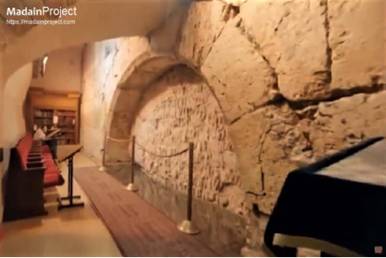
destruction of the second temple, is known today as Warren's
Gate. (image below)
And 100 years
later, the legend entered its most extraordinary chapter. It was
1981. A group of rabbis
led by Chief Rabbi Schlommo Goran and Rabbi Yehuda Mayor
Getat began secretly digging along the western wall
following ancient tunnels beneath the plaza. They inched forward
in the dArk foot by foot until according to Rabbi Gets's later
account they came to a sealed chamber and he claimed he had seen
the Ark of the Covenant on the other side
of a stone wall.
But before they could break through that final wall, Muslim
authorities discovered the dig. Violent clashes erupted on the
plaza. And to head off an open religious war, Israeli
authorities sealed the tunnel with concrete blocks. Today, that
tunnel remains sealed. Warren's gate still lies behind the
concrete. The place where the Ark might be.
But there's a problem.
And it's not archaeological. It's political.
Atop the rock where Solomon set the Ark now stands. The Dome of
the Rock, Islam's third
holiest site. Any digging beneath the Temple Mount would ignite
a global crisis. And so this theory just sits there waiting,
waiting for the day the world can
bear what might lie
below.
Meanwhile, just a few yards from the Western
Wall behind a concrete
wall, the most sacred object of antiquity could be quite
literally waiting in the
dark. But there's another theory about what became of the Ark.
Second theory – Mount Nebo
We left Jerusalem in
flames and headed east. We crossed the Jordan in the opposite
direction from Joshua. We climbed
out of the plains of
Moab to a solitary mountain 830 m. high, Mount Nebo. From its
summit, on a clear day,
you can see Jericho. You can see the Dead Sea. You can see the
Jordan Valley. And in
the distance, the hills where Solomon's temple once stood. Here,
Moses died. From here he gazed upon the Promised Land he would
never enter.
And according to
one of the oldest traditions, the Ark returned here to be hidden. The
source is second Maccabees, a book outside the Hebrew cannon,
revered for centuries and still
held sacred by the Catholic Church. It tells the
following. Before the Babylonians breached Jerusalem's walls,
the prophet Jeremiah received a divine revelation. He took the
Ark, the tabernacle, and
the altar of incense, and he spirited them out of the city in
secret. He crossed the Jordan. He climbed
Mount Nebo, and there on
the very mountain where Moses had been buried a thousand years
earlier, he found a cave. He placed
the sacred objects
inside. He sealed the entrance with stones, and he
said to those who were
with him, "This place must remain hidden until God gathers his
people again."
For more than 2,000 years, archaeologists, explorers, and
seekers have combed Mount Nebo in search of that cave. In the
1970s, Franciscan priests excavated parts of the mountain and
uncovered Byzantine ruins, mosaics, an ancient church, but no
sealed chamber with the Ark inside. Some believe it never
existed. Others insist the cave is real. But the mountain itself
has changed... landslides, the centuries, and oblivion have
rendered it invisible. And if they ever dug in the right place,
and the rock split, and
a faint light slipped into a passage sealed since the days of
Jeremiah, then perhaps there, beneath the dust,
the Ark would be there
waiting.
Let's pick up with the third theory, which takes us in
the opposite direction,
south to Egypt.
Third theory – The Island Elephantine
This theory holds that priests
loyal to the Temple, knowing Jerusalem was about to fall,
spirited the Ark out of the city, and they took it to the one land where
a Jewish community could shield it from Babylon's reach, Egypt.
This theory has a strong
biblical anchor that almost noone mentions.
Because after Jerusalem fell, Scripture records something
very specific. A group
of Jews fleeing disaster had forced the prophet Jeremiah and his
scribe Baruch to go with
them to Egypt. Not
in the
Apocrypha. It's in Jeremiah chapters 43 and 44. There was quite
literally an exodus south
in the months after the siege. And within that exodus, according
to the theory, someone carried the Ark to an island in the
middle of the Nile, Elephantine Island.
There in the fifth
century BC, a Jewish military colony served the Persian Empire.
And the most astonishing part: they had
their own temple -
a
functioning, Jewish temple, complete with sacrifices, on Egyptian
soil, while Jerusalem lay in ruins. The Elephantine papyri that were
discovered confirm it. That temple didn't spring from nothing. Someone founded
it. And the leading
theory says it was established by the descendants of those
priests who had fled with Jeremiah,
carrying the sacred object that had to be protected
until the homeland was livable again.
From Elephantine, the Ark could have kept traveling
up river. It might have
crossed into the land of Kush. It may have lain hidden in some
lost sanctuary of the Nubian desert. Archaeologists
have excavated
Elephantine for more than a century. They've found documents,
coins, the temple's ruins, remnants of houses, but not the Ark.
Even so, the theory endures because in 410 BC, Egyptian priests
destroyed the temple at Elephantine. The Jewish community
scattered and with them,
the Ark (if it was ever there) moved on.
If the Ark had slipped into
Egypt to escape Nebuchadnezzar, it wouldn't have stopped at the
first safe city. It would have kept going until it reached the
place where according to
one of the oldest living traditions on earth it is still guarded
to this day. And that
place is Ethiopia.
Fourth theory - Ethiopia
This theory hits hard because in the previous four stops
we hunted traces,
stones, caves, tunnels, documents. But here we're not after
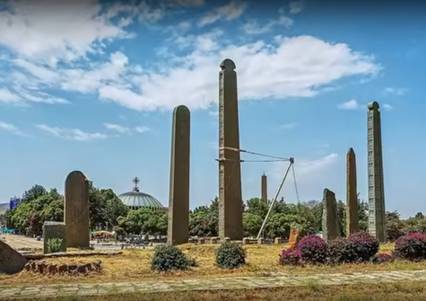
clues. Here a living man says he has the Ark. We're in Axum, a city in northern Ethiopia ringed
by mountains, full of stone obelisks that have stood for
2,000 years. (photo
below)
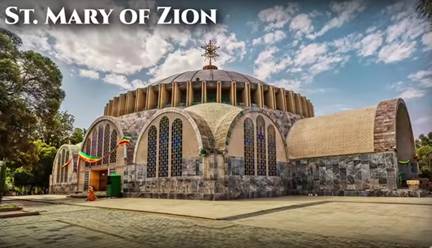
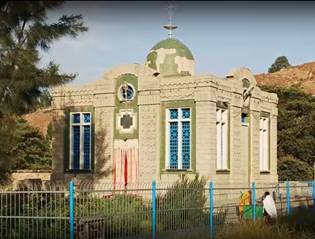
At the heart of the city stands a church called St. Mary of
Zion. (photo below)
And right beside it, a
small chapel fenced in by iron railings. (photo below)
Inside that chapel, a lone monk keeps vigil
day and night. He claims
to be the guardian of the Ark of the Covenant.
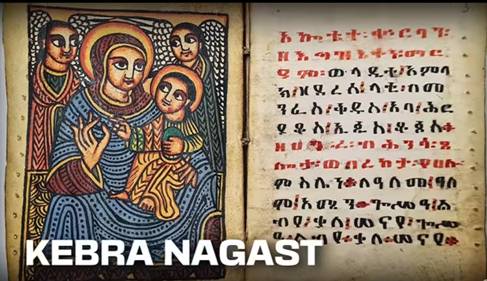
To understand how the Ark could have ended up in Africa, you
need to know a certain book. A book that outside Ethiopia almost
no one has read. It's called the Kebra Nagast (The glory of the
kings), the Christian national sacred text
of Ethiopia. (photo below)
Compiled in the 14th century, it preserves far older traditions.
For Ethiopians, it's as true as the Bible. And
its story begins with an
episode that's also in the Bible.
In 1 Kings 10, we're told that a queen from the south
traveled to Jerusalem to
meet Solomon. She was the queen of Sheba. She arrived laden with
gold, spices, and precious stones.
Up to that point, the Bible and the Kebra Nagast tell the
same story. But the
Ethiopian text keeps going where the Bible stops. And it says
that from that meeting
between Solomon and the Queen of Sheba, a son was born. His name
was Menelik. Menelik grew up in Ethiopia with his mother. When
he came of age, he traveled
to Jerusalem to meet his father. Solomon received him with
honor. He taught him the law. He anointed him king right there
in the Temple. And when Menelik chose to return to his homeland,
Solomon sent with him
the firstborn sons of Israel's most important priestly families
as his escort.
This is where the unexpected begins. Because one of those young
men was named Azariah. He was the high priest's son. The night
before their departure, he slipped secretly into the Holy of
Holies. He swapped the Ark for a wooden
replica overlaid with
gold and he carried off the original Ark. According to the Kebra
Nagast, God himself
approved the theft. The text says that during the journey, the
chariots lifted into the air by themselves whenever they carried
the Ark. They crossed
the Red Sea without difficulty. And when Solomon sent an army to
pursue them, it couldn't catch them. For Ethiopians, the
true Ark didn't wait for Nebuchadnezzar's siege. It left
Jerusalem 300 years
earlier in Solomon's day and it has never returned since. It
sounds like a medieval legend, but there's a detail
that makes you see this story in a new light.
In Ethiopia, since very ancient times, there has been a Jewish
community called the
Beta Israel. They're also known as the
Felashas. They are Jews,
but they practice a very ancient form of Judaism. They have only
the Torah. They don't know the
Talmud. They don't celebrate Hanukkah.
That means Judaism reached Ethiopia before the Babylonian exile,
before the later rabbinic tradition even took shape. What could
have sparked such an
early arrival? Ethiopian tradition answers without hesitation.
Menelik, Azariah, the Ark - and there's more. That same tradition
says that during its
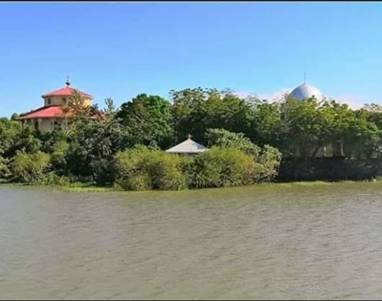
first 800 years in Ethiopia, the Ark wasn't in Axum. It was on a
small island in Lake Tana
in the south of the country. The island is called
Tana Kirkos
- Lake Tana of the Church.
To this day, there's an
active monastery on that island. The monks show visitors very
ancient ritual objects that
they say were used with the Ark during its time there.
The Ark's final move to Axum likely took place in the 4th
century AD under the reign of
Azana, Ethiopia's
first Christian king.
Under him, Ethiopia became one of the world's first Christian
nations even before
Rome. When Ethiopia embraced Christianity, the Ark found its
permanent home in the chapel where
it remains today. A single monk guards it. He is called the
Atang. He is chosen by the
patriarch of the church. Once chosen, he enters the chapel and
never leaves. He never sees sunlight
again. He never speaks to his family again. He dies in that
room. And before he
dies, he appoints his successor. No one else ever sees it. Not
the patriarch, not the bishops, not the emperors
of old, not today's
presidents. Once a year at Timcot, the feast celebrating
Christ's baptism, replicas of the
Ark, called Tabots, are carried in procession across the country.
Every Ethiopian church
has its own Tabot. Without it, it isn't considered a church. But
the original never moves.
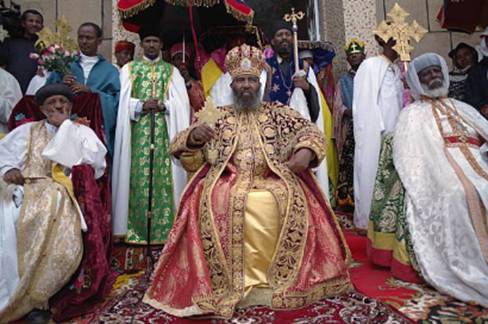
And there's a recent episode
worth remembering. In 2009, the patriarch of the Ethiopian
Orthodox Church,
Abuna
Paulos*,
called an international press conference. He announced to the
world that he would reveal for the first time
in history the Ark of
the Covenant. The announcement raced around the globe, but 24
hours later, he walked it back. No explanations, no apologies,
and he never spoke of it again. Some said he faced political
pressure. Others claimed the
traditional guardians vetoed it. Still others said he realized
the weight of what he was about
to do. Journalists and scholars have spent decades
trying to get answers. The monk speaks through a screen.
He'll talk about faith,
about the liturgy, about his mission, but he never invites
anyone in. Skeptics say
there is no Ark in Axum, that it's a legend, that it's a symbol.
*Abuna
Paul was the fifth Patriarch of the Ethiopian Orthodox Tewahedo
Church, serving from 1992 until his death on August 16, 2012.
Born in 1936 as Gebremedhin Woldeyohannes, he was also known as
a UN Nansen laureate for his work with refugees.
And there are still four more theories.
Fifth theory - Qmran
We move east from Jerusalem toward the Dead Sea. The place is
called Qumran. And here
in 1947, one of the most important discoveries in history took
place. A young Beduin shepherd was searching for a
lost goat among the
limestone cliffs. To see if the animal was hiding in one of the
crevices, he tossed a stone
into a cave. Suddenly, he heard a dry metallic clatter. It was
the sound of pottery shattering. What he discovered
inside left the world
speechless. Inside he found several sealed clay jars, and within
them were parchment scrolls
wrapped in linen. They had lain there untouched for more than
2,000 years. This shepherd had just uncovered the Dead Sea
Scrolls, manuscripts
hidden for 2,000 years by a first century Jewish community, the
Essenes. Most were copies of the books of the Old Testament,
texts written before
Jesus and in his very time. But one scroll was different.
A scroll that defied all archaeological logic. The so-called
copper scroll was
discovered in 1952 in cave 3. A roll made from a sheet of nearly
pure copper. It was a baffling find
because copper wasn't used for writing. It was extremely costly
and difficult to inscribe. Time had corroded it so badly
that unrolling it would
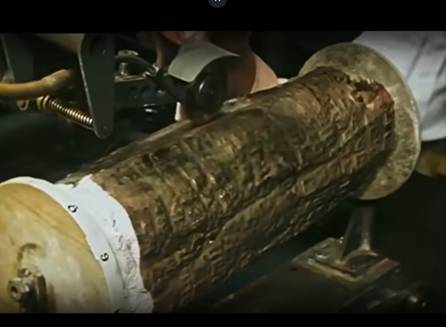
have made it disintegrate. So it was sent to Manchester where
using a saw with surgical precision,
they cut it into 23
strips to read what was inside. (photo below)
And when they fit the pieces together, they uncovered something
that stunned the world. It wasn't a biblical text. It was the
greatest treasure map in human history.
The copper scroll is in
fact a list of 64 locations where 26 tons of
gold and 65 tons of
silver were hidden along with incense and sacred garments. The
magnitude of this wealth is so immense that researchers agree it
could not have belonged to the small community that lived at
Qmran. Everything points to
this being the actual inventory of the treasures of Jerusalem's
second temple hurriedly hidden away before the Roman legions
arrived. Many believe that as the relentless Roman army closed
in, the temple treasurers spirited Jerusalem's gold reserves out
of the city and buried them in the desert.
The copper scroll, they
say, was the official record so that after the war, the people
could reclaim what was theirs. That's
why the text lays out
with precision the 64 locations with directions to places like
tunnels, cisterns, and
deep wells. So, here's the question. Was the temple treasure
still hidden in those places?
Many have tried to follow the map, but no one has found the Ark
to this day. The treasure remains one of archaeologyy's greatest
unsolved mysteries. The main problem is that the landscape has
changed. Landmarks like the fourth well or the entrance to the
White Cave were obvious 2,000 years ago. But today, after
centuries of earthquakes and erosion, those markers have
vanished.
Some of the hiding places are downright strange. One mentions a
chest of sacred garments
concealed beneath a staircase. Another speaks of a
chest of gold in a
secret chamber.
And there is one last cache, the most intriguing
of them all. The
original phrase is in ancient Hebrew, and translators still
debate it. Some read it
as "the vessels of the tabernacle". Others read it
as "the objects of the
first sanctuary". If that second reading is correct, the copper
scroll wouldn't be
describing the treasure of the second temple. It would be
describing the treasure of the first: Solomon's
temple. And among those
items, the Ark might be there.
Of the 64 hiding places, fewer
than five have been identified with certainty, and every one that
has been excavated was
empty. Could it be that the Romans got there first and looted
them? Or that the priests
moved the treasures at the last moment? Or even that the names
on the scroll are a cipher meant to
throw thieves off the
trail? No one knows. But the Ark of the Covenant may still lie
hidden in one of these 64
locations, waiting for 2,000 years for someone to decipher the
treasure map.
Sixth theory: Mount
Calvary.
No theory about the
Ark
has stirred as much fascination as that of a nurse from
Tennessee named Ron Wyatt. Wyatt wasn't an archaeologist.
He held no degree in
biblical history. He didn't work for any university. But in the
1980s, he made an
astonishing claim.
He claimed to have found the Ark of the Covenant. And he said
he'd found it in the most unlikely place of all, beneath Mount
Calvary. It was 1982. And according to his own account,
Wyatt was excavating in
a quarry north of Jerusalem's walls. Very near a spot some
consider the true site of Jesus's Crucifixion - the Garden Tomb.
He found a crack in the rock. He
squeezed into a narrow tunnel. He descended several meters, and
he reached a hidden chamber.
There, he said, he saw objects draped in animal skin covers,
brittle with age. among them the Table of the Bread of the
Prothesis, the
7-branched lampstand, and at the center, the Ark of the
covenant. But the most arresting
part of his account wasn't the Ark.
It was what was on the Ark. According to Wyatt, a fissure in the
chamber's ceiling ran
straight up to the surface of Mount Calvary, to the very hole
where the cross of Christ had stood. And through that crack,
when Christ died and a
Roman soldier pierced his side with a spear, the blood of Jesus
would have dripped some
65 ft down, falling drop by drop onto the Ark's Mercy Seat,
literally fulfilling the Yom Kippur rite, sealing in stone and in
blood, the old Covenant with
the new.
Wyatt said he took photographs. He said he took samples of the
blood. He said he sent those samples to a laboratory and the
analysis reported the impossible. The blood was alive.
It carried chromosomes
from a single male line with no genetic contribution from a
woman. (Note:This conflicts with the Virgin Mary's gestation)
But the archaeological community
rejected it all. No independent laboratory verified the results.
Wyatt never produced the original photographs. The samples were
never examined by academic institutions. And the chamber he
described has never been found by any other explorer. Yet in
many Christian circles, Ron Wyatt's story spread
like wildfire. Books,
videos, conferences, millions around the world have heard some
version of this story.
Skeptics say Wyatt was a fraud, an author who crafted the
perfect tale to sell books and lead tours. Believers say he uncovered something so sacred that the establishment isn't ready to acknowledge it. The quarry is still there. The crack in the rock is still there. Mount Calvary is still there. and below, if Wyatt was right, the holiest object of the Old Testament and the holiest blood of the New Testament would be touching in the dark, bringing in literal silence the entire story of Redemption to a close. But no one has gone back into that chamber, or at least no one who came out alive to tell the tale.
There's one
last geographic theory, the most improbable and the most like a
novel.
Seventh theory: the
Knights Templar
We leave Jerusalem for the last time, but this time we don't go
east or south or down. This time we head for Europe. Year 1099,
the crusaders take
Jerusalem. 20 years later, in 1119, a small band
of nine French knights
founds a military order. Their official mission is to protect
Christian pilgrims traveling to the Holy Land. They call
themselves the Poor Knights of the Temple of Solomon, but
history knows them as the Knights
Templar. For nine years,
these nine knights set up their headquarters in one very
specific place, the ancient underground stables beneath
Solomon's temple,
right above the tunnels and caves, where, according to rabbinic
tradition, Josiah had hidden the Ark
5 centuries earlier. And
for those 9 years, they do none of what they had
promised. They protect
no pilgrims. They fight no battles. They just dig. When they
finally surface and
return to Europe, the Order grows at a baffling speed. They
amass an incalculable fortune. They raise
200 Gothic cathedrals in
under a century. They receive privileges from the Pope that
place them above kings and bishops. Where did all
that come from? The
theory put forward by several alternative historians says
something very specific. That the Templars found something in
the tunnels of the Temple Mount. Something so powerful it gave
them knowledge, influence, and
wealth without precedent - something, like the Ark of the
Covenant. According to this theory, the Templars smuggled it out
of Jerusalem and into France, then hid it inside
Chartres
Cathedral. Chartres is one of Europe's most enigmatic Gothic
monuments. A perfect labyrinth is inlaid in its floor. Carvings
on its stones depict the Ark, and sacred geometric measurements
that echo the
proportions of Solomon's temple.
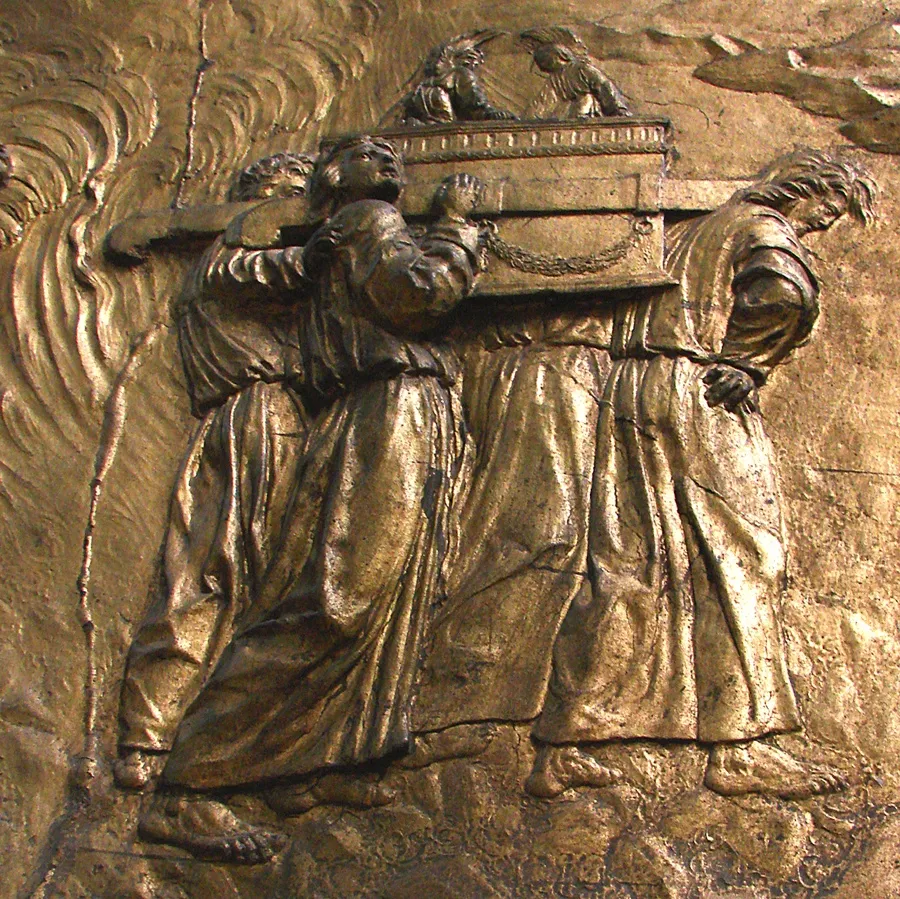
This bas-relief image showing the Ark of the
Covenant being carried is from the Auch Cathedral in France.
A newly translated Hebrew text claims to reveal the
locations of treasures from King Solomon's Temple and
discusses the fate of the Ark itself.
(Image credit: Photo by I. Vassil, released into public
domain through Wikimedia)
But the Templars’ story ends badly. The year is 1307.
King Philip IV of France, drowning in debt to the order,
orders a mass roundup. At first light on a Friday morning, the
Templars are seized, accused of
heresy, tortured, burned at the stake, but their
treasure never turns up.
And there's one detail
that keeps the theory spinning.
The Templar fleet slipped out of the port of La Rochelle
the night before the arrests, laden with the
Order's most valuable
treasures. Where did it go? Some say Scotland, others Portugal.
Still others all the way to the New World. And along each of
those routes, supporters of the theory point to clues. A carved
emblem in Rosland Chapel, Scotland.
A legend from an island in Nova Scotia. A cache beneath
the Templar Church in
Tomar, Portugal.
Most professional historians file all this under fiction, not
history. Not a single Templar document mentions the Ark. Not one
medieval chronicler records its journey. But if one day in a forgotten crypt in Europe, beneath a cathedral raised by Templar hands, someone were to lift a stone slab untouched for 700 years, they might indeed find something that would change everything.... or maybe they would find nothing, because the Ark never left the Holy Land.
One last theory remains, the deepest of them
all, and it appears on no map.
Eighth theory, the heavenly Ark.
There is one final place the
Ark could be hidden. And it isn't a cave or a tunnel or a
cathedral. It's the heavens.
To understand this, you have to open the letter to the Hebrews
written in the 1st century AD. There it explains something
almost no one mentions when people
talk about the lost Ark:
that the tabernacle Moses built at Sinai wasn't a human
invention. It wasn't
Bezel's design. It wasn't Moses's idea.
It was a copy:
“see that you make everything according
to the design shown you on the mountain.”
(Exod.25:40) Moses didn't invent a thing. He saw it. He saw it in a heavenly vision. And what he saw up there, he reproduced down here with acacia wood, gold, and blue dyed fabric. And that means the Ark of the wilderness, the one that crossed the Jordan, that brought down Jericho, that entered Solomon's temple, was a replica. The original was somewhere else. And it still is:
"Christ, High Priest of the good things to come,
through the greater and more
perfect tabernacle not made by human hands."
(Hebr.9:11)
The earthly Ark was a
shadow, a symbol with an expiration date, for a people who still
couldn't access the original. That's why
when the time came, the
copy was no longer necessary. That's why it
vanished without
explanation. That's why it doesn't appear on any Babylonian
inventory. That's why Jeremiah prophesied
that no one would miss
it. Because when the original arrives, the copy steps aside.
And the original came. On the day Jesus of Nazareth
died on a cross outside
Jerusalem, something happened that no historian
has ever been able to
explain. Inside the temple, hundreds of yards from the Cross,
the veil that separated the
Holy of Holies was torn in half: “And
behold, the veil of the temple was torn in two, from top to bottom”.
(Matth.27:51)
It stood 30 feet tall, as thick as the palm of a hand. So dense,
the rabbis said, that
even two teams of horses pulling in opposite directions couldn't
tear it. And yet, it tore on its own from top to bottom, so no
one could credit it to human hands.
For 1,500 years, that
veil had been the most sacred barrier on earth. It separated the
holy from the common. It kept the priest from the Ark. It kept
humanity from the throne of God. And on that Good Friday, the
barrier fell.
Pay attention to this. The Greek word Paul uses in his letter to
the Romans for Christ is “Ilasterion” And "I-la-ste-ri-on" literally
means “Mercy Seat” - the very name of the Ark's cover - the exact
spot where the blood of Yom Kippur was sprinkled: «25 Whom
God had set forth as an Ilasterion, through faith in his blood,
as an indication of His justice for the dismissal of past
committed sins."
(Rom.3:25)
Here the circle closes. The Ark was a piece of furniture, and
its cover was the precise place where God had promised to meet with
His people. Once a year, a single man sprinkled blood on it, to
make atonement for sins. Christ, by contrast, is a Person, and His blood isn't sprinkled once a year. It was poured out once and for all, forever. That's why the true Mercy Seat is no longer in a cave on Mount Nebo. It isn't under the Dome of the Rock, not on Elephantine, not in Qumran. He is alive.
And perhaps
that's
why the earthly Ark was "lost". Because it had already fulfilled
its mission. For nearly a thousand
years, it showed
humanity what a place looks like where heaven touches the earth.
And when that place became flesh, the goldplated acacia chest
slipped away quietly to sleep in some corner of History.
Maybe it no longer
exists. But in any case, it's no longer the center. The center
is someone else.
We have traversed more than 800 years of documented history.
We've followed the trail along the Jordan, through Gilgal,
through Jericho, and then we searched through the tunnels
beneath the Temple
Mount, through the highlands of Ethiopia, eight places where the
most sacred object in history might be waiting.
beneath the Dome of the
Rock, in one of the copper scrolls, on coded caches in a Templar
crypt somewhere in Europe.
But after all this
journey, the conclusion is surprisingly simple. The Ark was
never the goal. For nearly a millennium, the most
sacred object of
antiquity walked with a people across the world. It stopped
rivers. It toppled walls. It humbled idols. It claimed lives. It
blessed homes. And it stilled the
sun. But none of that was the point. It was all training - an
immense national multigenerational apprenticeship -
so that humanity would
learn a single truth: that
God desires to dwell with humankind.
And that is the greatest truth in this whole story.
An entire nation followed a chest of acacia wood overlaid
with gold because within
it dwelt the
promise that God wanted to be with humankind. That's why if someone discovered the Ark tomorrow, the world would shudder; cameras from every corner of the globe would lock onto that spot and the headlines would run for months. But even if that Ark were found, it would be only an ancient piece of furniture, because the true Mercy Seat is no longer kept in any box.
The true Mercy Seat has a name, and that
name is Jesus.
The way is open. |
Article created : 30-07-2026
Last update on: 30-07-2026